
What is Brandonite ?
Brandonite® is a broad family of high performance composite materials designed to replace metals, plastic or rubber. Our material formulation experts can custom blend the polymers to create a composite that will perfectly meet your product’s unique requirements, guaranteeing that your part will perform as expected, each and every time.
This family of composite materials is perfect for a broad number of applications, such as:
- aerospace
- aeronautics
- industrial manufacturing
- self-lubricating parts and materials
- automation equipment
- radiation shielding
- antimicrobial medical devices,
- coverings, and prosthetics
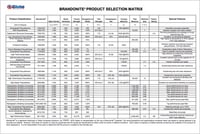
The Brandonite® Matrix
You can download this product selection matrix to discover Brandonite Product Classifications and Specifications, and Special Features of Individual Brandonite Materials
A Few Brandonite Composites
Brandonite 1200-60A is a family of flexible, high-strength materials that are ideal for demanding gasket and sealing applications. This material will not take a compression set and yields a tensile strength of up to 4,500 PSI while having a low durometer, 60A. This material can be bonded onto a variety of materials, including 316 stainless steel and titanium.
Brandonite 4210 (High-Gravity Composite) is a polymer-metal composite that matches the density of lead. It is heavily used in the medical and aerospace industries as a cost-effective, non-toxic alternative for radiation shielding (e.g., in CT scanners and X-ray equipment). Hear more about HGC in an interview with Composites Weekly.
Brandonite 9012 series of material are infused with a unique nanosilver substance where the composite base polymer, nanosilver, and FDA-approved fibers are compounded together without degrading the structural performance of the end-product. This makes the composite not only immensely strong and durable, but the composite itself is inherently anti-microbial. The infused silver remains suspended throughout the entirety of the composite material, slowly extracting over a period of time via the surface of the material.