

Part II: The Next Phase of Autonomous Naval Warfare
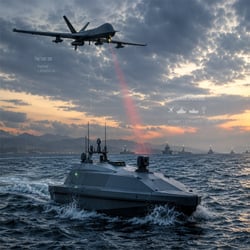
In Part I: From Force Multiplier to Frontline Asset, we examined a fundamental shift taking place across the modern battlespace, where unmanned systems are moving beyond their traditional roles. Recent military exercises in China suggest the next phase of that transition may already be underway.
The People's Liberation Army Ground Force recently trained with armed KVD002 unmanned combat aerial vehicles against fast-moving unmanned surface vessels, with Chinese military footage showing the aircraft engaging drone boats with missiles.
The significance extends beyond the individual platforms. Militaries are beginning to develop tactics specifically intended to detect, track, engage, and destroy other unmanned systems.
From Frontline Asset to Frontline Target
When an adversary begins developing tactics specifically to defeat a capability, that capability has crossed an important threshold.
Ukraine's maritime drones have already demonstrated their ability to threaten conventional naval assets and alter fleet behavior. The Chinese exercise illustrates the corresponding response: military planners are now considering not only how unmanned systems will be employed, but how they will be found and destroyed.
It remains unclear whether the exercise specifically simulated U.S., Taiwanese, or allied unmanned vessels. What matters is that fast-moving USVs are now significant enough to appear as targets in military training.
The employment of unmanned systems against other unmanned systems marks the next stage in that progression.
The progression from frontline asset to frontline target introduces a different set of requirements. Survivability, signature, communications resilience, adaptability, and cost become increasingly important alongside traditional measures of platform performance.
From the Black Sea to the Western Pacific
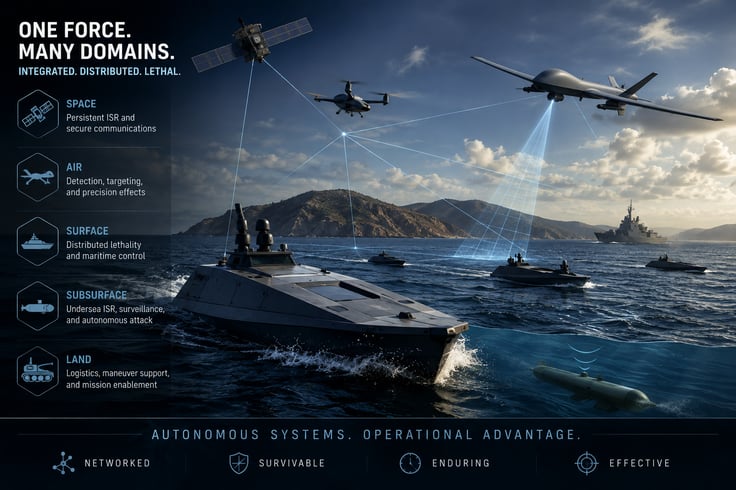
Lessons from the Black Sea are already migrating to the Western Pacific. During the U.S.-Philippine Balikatan 2026 exercise, U.S. special operations forces operated a Ukrainian Magura unmanned surface vessel equipped with an explosive payload to sink a target vessel in the Luzon Strait.
At the same time, China is practicing ways to defeat them.
The cycle is becoming clear: operational innovation drives deployment, deployment drives countermeasures, and countermeasures drive the next generation of innovation.
More consequential than any individual platform may be the speed of that cycle.
The Counter-Autonomy Challenge
For naval planners and acquisition organizations, the objective cannot simply be to field unmanned or autonomous systems quickly. Those systems must remain operationally relevant as the threat evolves around them.
Range, speed, payload, autonomy, and cost remain important, but counter-autonomy introduces another requirement: Can the platform continue to accomplish its mission while being actively detected, disrupted, and engaged?
This is particularly important for attritable systems. Attritable does not necessarily mean disposable. A platform that is inexpensive but easily disabled may provide limited operational value, while excessive protection and redundancy can increase cost until the advantage of attritability begins to disappear.
The objective may therefore be mission-appropriate survivability, balancing capability, endurance, resilience, and cost against a threat environment that will continue to evolve.
Why Materials Matter
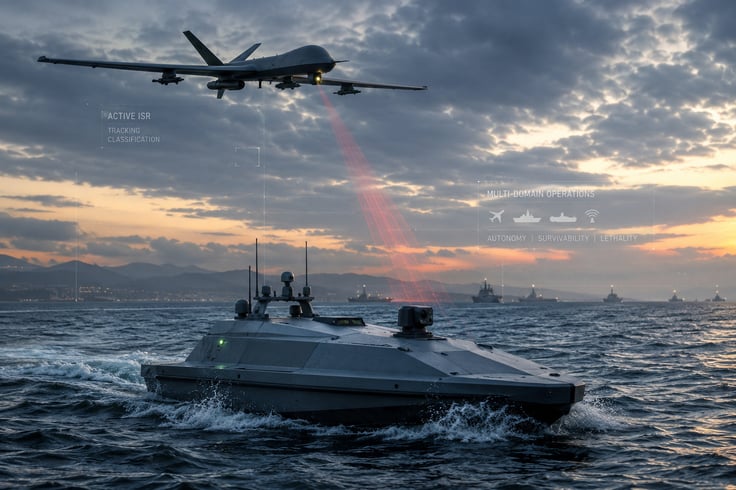
This evolving threat environment places greater emphasis on materials and structural design. Without onboard damage control, structures and systems may need sufficient damage tolerance to complete the mission or reach recovery after an engagement.
Unmanned and autonomous maritime platforms must also balance weight, payload, range, signature, reliability, survivability, and cost. Lightweight composite structures can contribute through reduced structural mass, corrosion resistance, buoyancy, durability, and lower maintenance requirements.
Reducing structural mass can translate directly into additional fuel, batteries, sensors, payload, or range. Depending on material selection and structural design, advanced composites can also support electromagnetic transparency, signature management, impact resistance, and buoyancy.
The objective is not simply a lighter vessel, but a better balance between range, payload, signature, survivability, cost, and mission effectiveness.
The Next Phase of Autonomous Warfare
Counter-autonomy also places pressure on traditional acquisition cycles. Platforms, payloads, communications, tactics, and countermeasures can evolve far faster than conventional defense programs.
For the Navy, NAVSEA, DARPA, defense primes, non-traditional suppliers, and the broader industrial base, the ability to rapidly prototype, manufacture, test, and modify systems may become an operational advantage. Modularity, open architectures, and manufacturing flexibility will increasingly determine how quickly a platform can respond to an evolving threat.
The most successful unmanned system may not be the platform with the highest performance when it enters service, but the one that can adapt fastest after an adversary develops a way to defeat it.
In From Force Multiplier to Frontline Asset, we argued that unmanned systems were becoming central to future military operations. The emerging counter-autonomy environment advances that argument one step further.
The progression is increasingly clear: force multiplier, frontline asset, frontline target.
As unmanned systems begin hunting other unmanned systems, the next transition may be toward increasingly autonomous detection, classification, and engagement. Competitive advantage will favor platforms that can survive, adapt, and evolve faster than the systems designed to defeat them.