
Part I: The Rise of Autonomous Systems in Modern Warfare
How a Drone Strike and a USV Rescue Reveal the Future of Naval Warfare
For decades, unmanned systems have been viewed primarily as force multipliers - valuable tools that extend the reach of military forces through reconnaissance, surveillance, communications, and intelligence gathering. While these systems have delivered significant operational advantages, they have traditionally played supporting roles alongside crewed platforms.
Recent events suggest that distinction is rapidly disappearing.
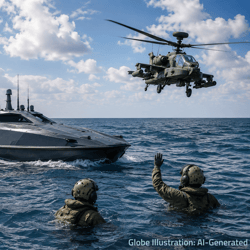
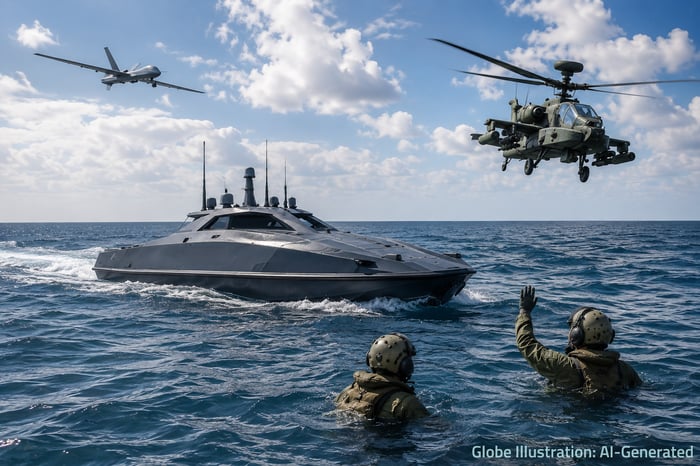
A recent incident near the Strait of Hormuz offers a compelling example of this evolution. After an Iranian drone brought down a U.S. Army AH-64 Apache attack helicopter operating near Oman, a U.S. Navy Uncrewed Surface Vessel (USV) was deployed to help locate and recover the downed pilots.
In a single event, an autonomous system delivered the threat, while another autonomous system contributed to the response.
For defense planners, acquisition professionals, and naval strategists, the implications are difficult to ignore.
From Supporting Capability to Mission Execution
Military organizations have spent years integrating autonomous technologies into operational environments. Early deployments focused on expanding situational awareness, collecting intelligence, reducing risk to personnel, and supporting decision-making. The expectation was that unmanned systems would enhance the effectiveness of traditional forces rather than replace them.
Today's autonomous platforms are no longer limited to gathering information or extending operational reach. Increasingly, they are conducting missions that directly influence operational outcomes. The distinction between supporting capability and mission-critical asset is becoming increasingly blurred.
The Strait of Hormuz rescue demonstrates this shift in practical terms. The USV was not deployed to collect data or expand surveillance coverage. It was tasked with helping execute a mission traditionally assigned to crewed assets, illustrating the growing operational trust being placed in autonomous maritime systems.
A Pattern Emerging Across Modern Conflict
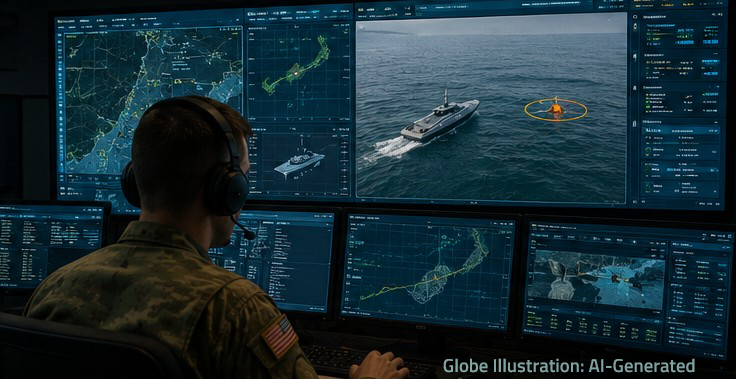
The Hormuz incident is not an isolated event. It reflects a broader transformation that has accelerated across multiple theaters and domains in recent years.
The war in Ukraine has provided one of the clearest demonstrations of how unmanned systems can alter the operational balance. In the Black Sea, Ukrainian uncrewed surface vessels have challenged conventional assumptions about naval power by threatening larger, higher-value Russian naval assets and forcing changes in fleet behavior. These platforms have demonstrated that relatively small, distributed, and difficult-to-detect systems can impose significant operational costs on a traditional fleet.
Ukraine's maritime drones have also evolved beyond one-way strike missions. Reports indicate that uncrewed surface vessels have been adapted for longer-range operations, larger payloads, and increasingly complex mission profiles, including the potential to launch aerial drones from the sea. This progression underscores a larger reality: autonomous systems are not static capabilities. They are rapidly iterated, adapted, and reconfigured based on operational need.
The same trend is evident in the air domain. Across the Ukraine/Russia conflict, drones have become essential to reconnaissance, targeting, strike coordination, artillery adjustment, logistics disruption, and tactical attack. In many cases, drones are no longer peripheral tools supporting traditional formations; they are central to how those formations find, fix, and engage targets.
On land, Ukraine's growing use of unmanned ground vehicles (UGVs) for reconnaissance, logistics, casualty evacuation, mine clearance, and combat support further demonstrates how autonomous systems are expanding beyond niche applications. Missions once assigned exclusively to human operators are increasingly being performed by autonomous platforms.
Beyond Ukraine, drones have become persistent elements of military activity throughout the Red Sea and Arabian Gulf, conducting surveillance, targeting, and strike missions that were once the exclusive domain of manned aircraft. Beneath the surface, autonomous underwater systems are expanding the reach of naval forces through mine countermeasures, intelligence collection, seabed operations, and persistent undersea surveillance. These capabilities are becoming increasingly important as strategic competition intensifies across the maritime domain.
Taken together, these developments reveal a common reality: the future battlespace will not be defined solely by ships, submarines, aircraft, and ground forces. It will be shaped by networks of autonomous systems operating across air, land, surface, and subsurface domains.
For naval planners, acquisition professionals, and defense technology developers, the lesson is clear. Autonomy is no longer a specialized capability operating at the margins of warfare. It is becoming a foundational element of future force structure, distributed maritime operations, and multi-domain combat. The question is no longer whether autonomous systems will play a central role in future conflicts, but how quickly military organizations can adapt their doctrine, acquisition strategies, and fleet architectures to fully leverage their potential.
When Force Multipliers Become Frontline Assets
Historically, military technologies follow a predictable progression. New capabilities are initially introduced as supplements to existing systems. As performance improves and operational confidence grows, those capabilities assume greater responsibility. Eventually, they become indispensable.
Autonomous maritime systems appear to be approaching that threshold.
USVs are conducting reconnaissance, force protection, and maritime security missions. Autonomous underwater vehicles are expanding undersea awareness and supporting critical naval operations. AI-enabled systems are accelerating data analysis and decision-making. Autonomous logistics platforms are extending operational endurance in distributed environments.
Most importantly, these systems are increasingly being trusted with missions that directly affect operational success.
For naval leaders, the implications extend beyond individual platforms. Future fleet architectures will increasingly depend on a mix of crewed and uncrewed systems operating as an integrated force. The challenge is no longer determining whether autonomous systems belong in the fleet, but how they should be organized, procured, sustained, and employed to deliver operational advantage across contested maritime environments.
That shift is already influencing how navies think about force design, readiness, and long-term acquisition priorities.
Why Materials Matter
As autonomous systems assume greater operational responsibility, platform performance becomes increasingly important. Unlike traditional crewed vessels, autonomous platforms must maximize endurance, payload capacity, reliability, and survivability while minimizing maintenance requirements and lifecycle costs.
These requirements place greater emphasis on advanced materials and manufacturing approaches.
Lightweight composite structures offer significant advantages for autonomous maritime platforms, including reduced weight, improved fuel efficiency, greater buoyancy, corrosion resistance, and lower maintenance demands. These benefits enable greater range, longer mission duration, and increased payload flexibility; critical factors for systems expected to operate independently in demanding maritime environments.
As navies continue investing in autonomous fleets, material selection will become a critical enabler of operational performance, platform survivability, and lifecycle affordability. The ability to build lighter, more durable, and lower-maintenance autonomous systems will directly influence how effectively future fleets can scale and sustain distributed operations.
Looking Ahead
The Defense community has spent years discussing autonomous systems as force multipliers. Recent operational experience suggests they are becoming something more.
From the Black Sea to the Arabian Sea, autonomous systems are increasingly conducting missions that directly influence operational outcomes. They are finding targets, delivering effects, gathering intelligence, extending operational reach, and, in some cases, helping save lives.
For naval leaders, acquisition professionals, and defense planners, the lessons emerging across today's battlespace point toward the same conclusion: autonomous systems are no longer simply extending the reach of military forces. They are becoming an essential component of how future combat power is generated, distributed, and sustained.
The transition from force multiplier to frontline asset is no longer theoretical; it is already underway.
Continue the series: Part II — When Unmanned Systems Begin Hunting Each Other